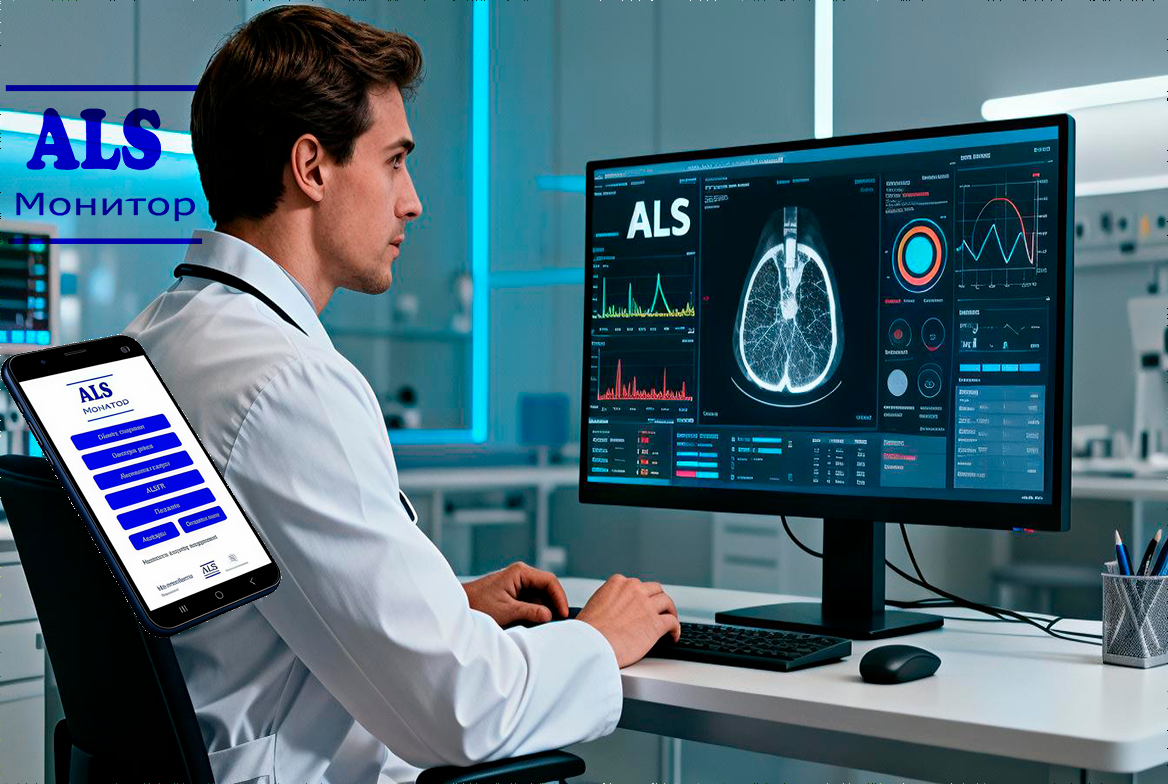
Monitoring the condition of ALS patients

About the ALS Monitor project

Amyotrophic lateral sclerosis (ALS) is a severe, relentlessly progressive neurodegenerative disease in which timely detection of changes is vital.

ALS Monitor is software that enables monitoring of the clinical condition of patients with amyotrophic lateral sclerosis (ALS), control of key parameters, analysis of risk factors, creation of personalised alerts (including those based on artificial intelligence), as well as the formation of a database and a national registry of patients with motor neuron disease, providing a detailed picture of the condition.

The problem addressed is the need for medical supervision of patients with ALS who are outside a hospital setting; without such monitoring, the disease may progress more rapidly.

The proposed solution is the ability to monitor clinical status and select personalised recommendations for patients with ALS using AI-based specialised software.

The software assesses the severity and rate of disease progression, nutritional status, daily caloric intake, and the dynamics of a large number of clinical parameters against the background of the natural course of the disease.

The solution consists of two main parts (for clinicians and for patients) and allows continuous monitoring of more than 400 parameters, timely correction of risk factors, evaluation of therapy effectiveness, and prediction of life expectancy in patients with ALS.

  1. The project “Digital system for monitoring the clinical condition of patients with amyotrophic lateral sclerosis — ALS Monitor”.
  2. A software product for monitoring clinical status, the dynamics of the main clinical assessment scales (ALSFR), nutrition and body weight. The product includes a client-side mobile application that can be installed on mobile platforms and used to track the dynamics of numerous indicators, detect clinically significant changes, and automatically generate recommendations. Based on the collected data and using multiple linear regression, the risk of disease progression is estimated. There are currently no direct analogues of this software worldwide; it enables accumulation of data on disease progression and assessment of the contribution of individual parameters.
  3. The mobile application uses artificial intelligence methods to recognise the severity of dysarthria and to construct a digital model of voice impairment, as well as a dataset reflecting the dynamics of the clinical status. The AI model is based on the Keras (TensorFlow) library. Several datasets have been created to assess nutritional status in patients with motor neuron disease.
Status assessment: muscle strength, simple movement analysis, heel and toe walking, and dynamics of protein, fat, and carbohydrate intake.
Voice tracking dynamics and dysarthria assessment using artificial intelligence methods.
Dynamics of protein, fat, and carbohydrate intake in ALS patients, calorie balance, and optimal diet calculation.
Nutrition diary and dietary dynamics in ALS patients.
Dynamics of the ALSFR scale.